

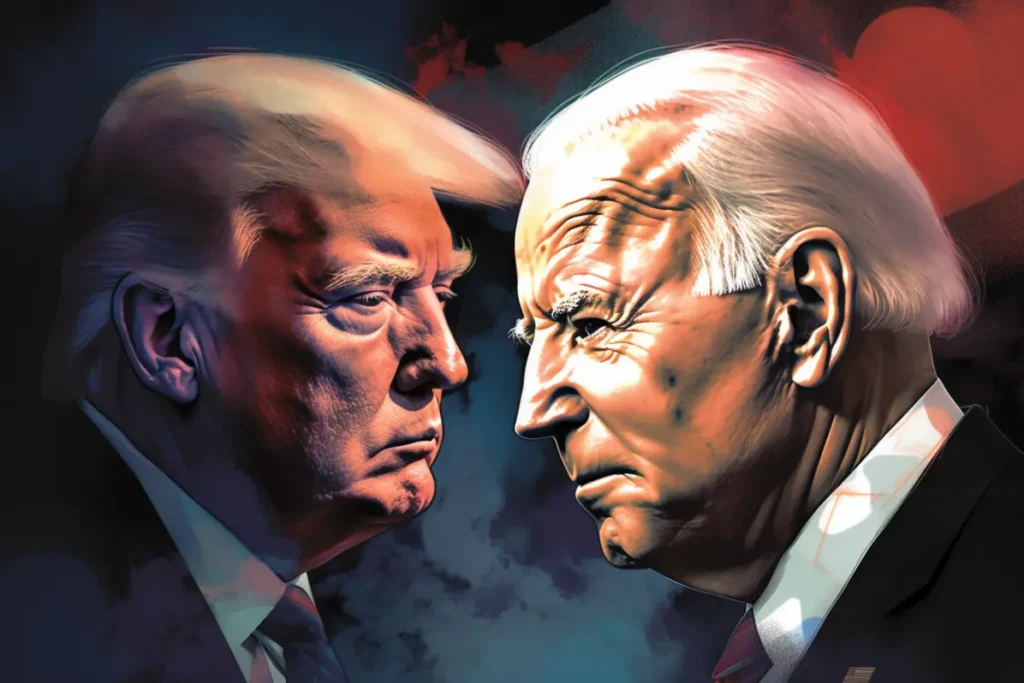
As the United States gears up for the 2024 presidential election, the nation finds itself in a unique predicament: the likely face-off between President Joe Biden and former President Donald Trump, two candidates who, according to a late August Associated Press poll, are not the top choices for many Americans. The poll’s findings paint a picture of voter dissatisfaction, with Biden being described as “Old,” “Outdated,” “Slow,” and “Confused,” and Trump as “Corrupt,” “Crooked,” and “Bad.” Despite this, both candidates lead significantly in their respective primaries.

The Republican Party has witnessed a rollercoaster of support for Trump. His influence seemed to wane following the 2021 Georgia Senate runoffs and the 2022 midterms, where the GOP’s underperformance was partly attributed to him. However, Trump’s indictment in March 2023 marked a turning point, reinvigorating his base and positioning him as a victim fighting against a perceived establishment. This resurgence overshadowed potential challengers like Florida Governor Ron DeSantis, who struggled to establish a strong campaign presence.
On the Democratic side, Biden’s path to the nomination appears unchallenged, despite a majority of Democrats expressing a preference for a different candidate. Concerns about Biden’s age and declining vigor are prevalent, yet no significant Democratic figure has emerged to contest his candidacy. The exception is Marianne Williamson, a fringe candidate with limited support.
The general election is poised to be a tight race, with a handful of swing states likely determining the outcome. Political commentator Chris Cillizza predicts Biden’s reelection, citing swing voters’ reservations about Trump’s character as a decisive factor. He also foresees Trump refusing to accept the election results, mirroring his response in 2020, and potentially running again in 2028.
The 2024 presidential race thus presents a unique scenario: two candidates with significant weaknesses and a general electorate grappling with a choice that many feel is less than ideal. The election is not just a contest between two individuals but a reflection of the broader political and societal dynamics at play in the United States. As the campaign unfolds, it will undoubtedly be a focal point for national and international attention, shaping the discourse on leadership, policy, and the future direction of the country.