


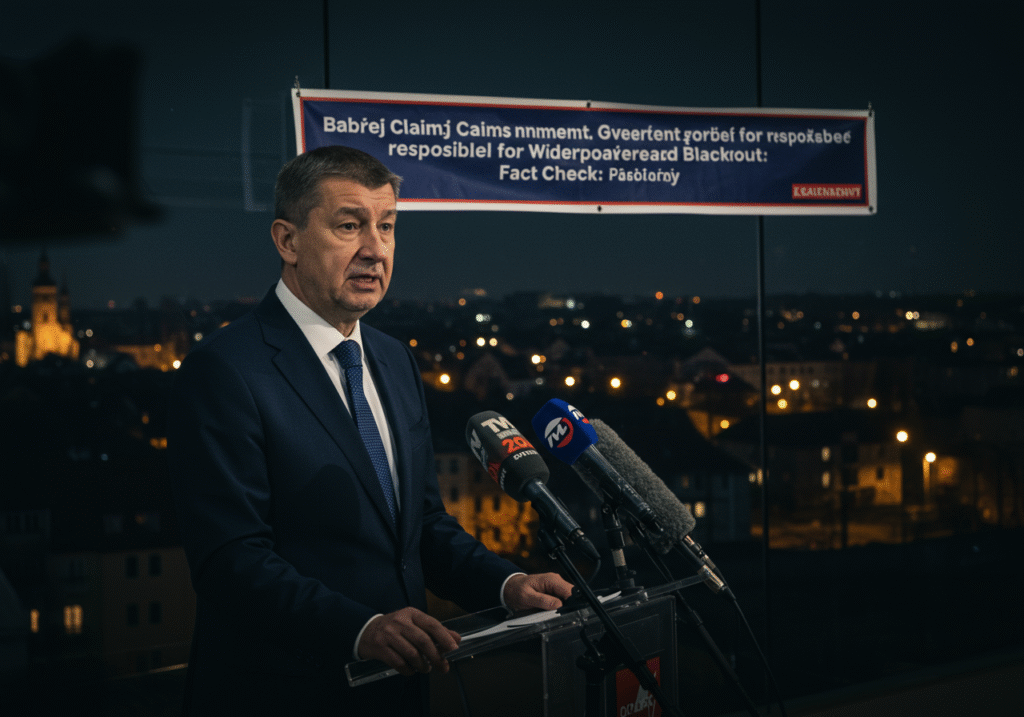
Amidst an unexpected wave of power outages sweeping across the country, former Prime Minister Andrej Babiš recently attributed the widespread blackout to the incumbent government’s shortcomings. The assertion, shared with a vast audience, has stirred a significant degree of controversy and debate, prompting both public concern and political intrigue. In this article, we delve into Babiš’s claims, provide a detailed analysis, and uncover the truth behind the alleged government responsibility.
Backdrop to the Blackout
The nationwide blackout that unfolded recently left numerous homes and businesses without electricity for extended hours, sparking public unrest and frustration. Families grappled with inconveniences, businesses faced losses, and essential services were disrupted. Understanding the root causes of such a widespread outage is essential to ensuring corrective measures and preventing future occurrences.
The Allegation: Government Inefficiency?
Andrej Babiš, during a public appearance, accused the current government of being directly responsible for the blackout. Babiš’s statement, made with an air of certainty, blamed the administration for negligence and mismanagement that allegedly contributed to the power grid’s failure. His remarks were met with widespread attention, due in part to his prominence as a former Prime Minister and influential political figure.
Response from the Government
In light of Babiš’s allegations, the government spokespeople were quick to respond. They refuted the claims, emphasizing that the blackout was caused by factors beyond their control. According to official statements, the outage resulted from technical failures within the national grid, unrelated to governmental actions or policies. They pointed out that teams were immediately deployed to restore power and investigate the incident’s specifics.
Looking at the Facts
To uncover the truth behind the competing narratives, it is crucial to examine the facts. This involves evaluating the technical aspects of the power grid, understanding the government’s energy policies, and scrutinizing the timeline of government interventions during the crisis. Independent analysts and industry experts offer valuable insights that help in dissecting the situation comprehensively.
- Technical Failures: Experts from the energy sector have indicated that technical failures, particularly in the aging infrastructure of the power grid, were significant contributors to the blackout. Issues such as overloaded circuits, deteriorated transformers, and inadequate maintenance were cited as underlying problems.
- Energy Policies: Evaluating the current government’s energy policies reveals a focus on transitioning towards renewable energy and modernizing infrastructure. However, such initiatives take time and substantial investment, potentially leaving gaps and vulnerabilities during the transition.
- Crisis Management: The speed and efficiency of the government’s response play a crucial role in determining their accountability. Records show that response teams were mobilized swiftly, and power restoration efforts prioritized critical areas such as hospitals and emergency services.
Public and Political Reactions
Babiš’s statement ignited a firestorm of political discourse and public opinion. Supporters of Babiš were quick to echo his sentiments, pointing to perceived inefficiencies and missteps by the current administration. Conversely, government allies defended their stance, emphasizing a commitment to transparency and improvement in infrastructure management.
Experts Weigh In
The involvement of energy experts, policy analysts, and independent auditors has helped in neutralizing politically charged narratives. Their assessments align with the evidence pointing towards technical inefficiencies as the root cause of the blackout, rather than direct governmental negligence. Additionally, the emphasis on infrastructure investment and modernization is highlighted as a necessary response to prevent future incidents.
Understanding the Political Implications
In the heated political climate, the blame game has broader implications. The discourse has intensified existing political polarization, with rival parties using the incident to gain political mileage. The allegations have fueled election rhetoric, as politicians on both sides capitalize on public concerns to push their agendas. As citizens grapple with the blackout’s aftermath, the need for clear, actionable plans to secure energy stability becomes all the more pertinent.
Moving Forward
The incident serves as a wake-up call to all stakeholders involved in national energy management. Beyond immediate fixes, there lies a need for strategic policies that address long-term infrastructure resilience and adaptation to a rapidly changing energy landscape. Collaborative efforts involving government bodies, private sector players, and international partners may be pivotal in crafting solutions that weather political and operational challenges.
As the dust settles on the political arguments surrounding the blackout, it becomes clear that the path to energy security requires a concerted, multipronged approach. While the governance blame attributed by Babiš serves as a poignant point of discussion, the larger picture emphasizes the importance of constructive dialogue and systemic reform.
Ultimately, the engagement of the public, industry experts, and political entities in a cooperative framework is crucial for fostering a robust energy future. The need to transcend political barriers and focus on sustainable, realistic solutions is critical to ensuring that the nation does not face a similar incident in the future.
The debate sparked by Babiš’s claims may linger in political circles, but the imperative to act becomes imperative for the country’s energy resilience and public trust. As dialogues continue, the focus will likely shift towards measurable outcomes that mitigate risks and optimize energy management strategies, safeguarding the populace against the uncertainties of power disruptions.