


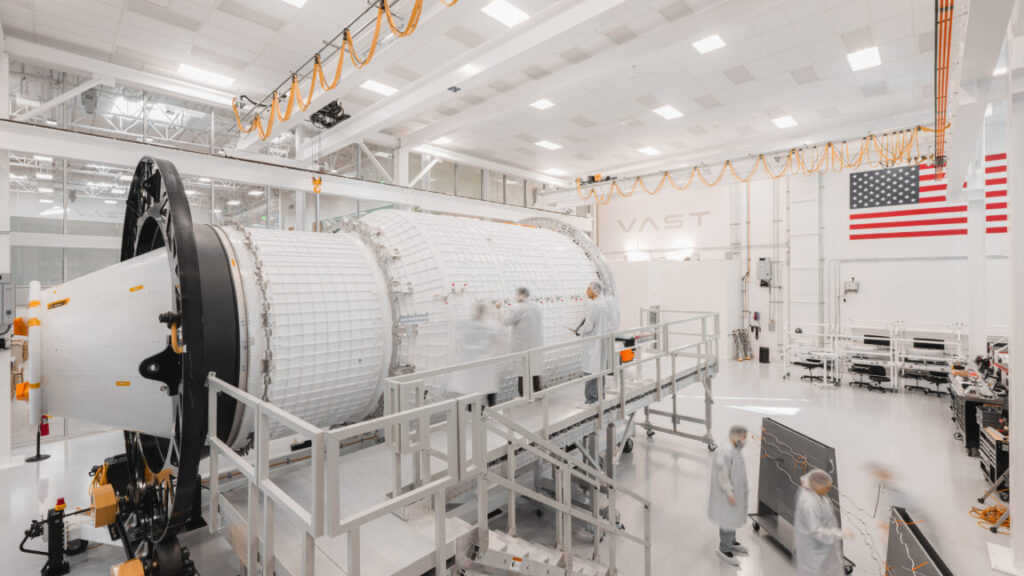
The assembly of Haven-1, the first commercial space station, marks a new chapter in human space exploration. Built by Vast Space, this ambitious project is set to revolutionize our approach to space habitation and commercial activities beyond Earth.
In the wake of the International Space Station’s (ISS) increasing age and its retirements in sight, the development of commercial space stations is crucial. Haven-1 promises to fill this emerging gap, serving not only as a hub for research and technology development but also as a potential home for tourists and private enterprises eager to venture into orbit.
Revolutionizing Space Habitation
Vast Space, a forward-thinking aerospace company, is spearheading the Haven-1 project from their headquarters in California. Their goal is to create a modular, scalable space station that can support various missions, from scientific research to commercial activities and tourism.
The project gains significance as it aligns with broader goals of expanding human presence in space. Designed with adaptability in mind, Haven-1 consists of modules that can be added as needed, offering versatile solutions to different entities desirous of conducting zero-gravity research or hosting astronauts and tourists.
Modular Design for Future Expansion
Haven-1’s modular design allows for dynamic scaling. This is particularly important given the unpredictability of future space needs. As technology advances and the demand for off-Earth operations grows, this flexibility ensures that Haven-1 can evolve and expand seamlessly.
The initial module is under construction and aims to be ready for launch as soon as 2029. Each subsequent module can attach to the original, forming a larger, interconnected station capable of supporting various missions and number of inhabitants.
Nurturing Space Commercialization
The successful launch and operation of Haven-1 could herald a new age of space commercialization. Unlike government-funded projects focused primarily on scientific research, commercial stations like Haven-1 offer potential for profitable ventures ranging from manufacturing to tourism.
Potential tenants span sectors from pharmaceuticals to materials science, each eager to exploit the unique environment of space for research and production. Similarly, space tourism is poised to become a booming industry, with Haven-1 providing an unprecedented platform for ordinary persons to experience the cosmos firsthand.
Innovation in Manufacturing and Research
Microgravity environments open new avenues for manufacturing processes and scientific experiments unfeasible on Earth. Materials created in space oftentimes showcase different properties—useful for industries exploring new technologies such as fiber optics and medicine. Haven-1 could be a focal point for such innovation, fostering breakthroughs with far-reaching implications for industries worldwide.
- Pharmaceutical advancements: Drug development research conducted in microgravity conditions can lead to more effective formulations.
- Material sciences: Unique conditions allow for the creation and testing of materials with properties unattainable on Earth.
- Biomedical research: Studying biological systems in a zero-gravity environment aids in understanding disease progression and body’s response to space conditions.
The Future of Space Tourism
As commercial space stations become more viable, the idea of space tourism has moved beyond science fiction. Haven-1 stands at the forefront of this potential transformation. With infrastructure to support a limited number of tourists, it makes the dream of seeing Earth from space a possibility for those with the means.
Vast Space plans to collaborate with leading space tourism companies to prepare for the logistical challenges inherent in hosting civilian visitors in space. Ensuring safety, comfort, and a rewarding experience for tourists are key priorities that guide the design and operational strategies of Haven-1.
A Leap Towards Mainstream Space Travel
The broadening of accessibility to space naturally raises questions about societal impacts and ethical considerations. While initially limited to the affluent, the potential trickle-down of technologies developed alongside Haven-1 could democratize space travel over time. As costs decrease and opportunities expand, diverse populations may find opportunities to participate in space travel, fostering a truly global engagement with space exploration.
The development and anticipated launch of Haven-1 mark a crucial phase in actualizing permanent human presence in orbit. As operational capability grows and cost barriers are surmounted, the future of space stations like Haven-1 could redefine how humanity interacts with space, encouraging both economic growth and an extended understanding of our place in the universe.
, image: https://arstechnica.com/space/2026/01/the-first-commercial-space-station-haven-1-is-now-undergoing-assembly-for-launch/