


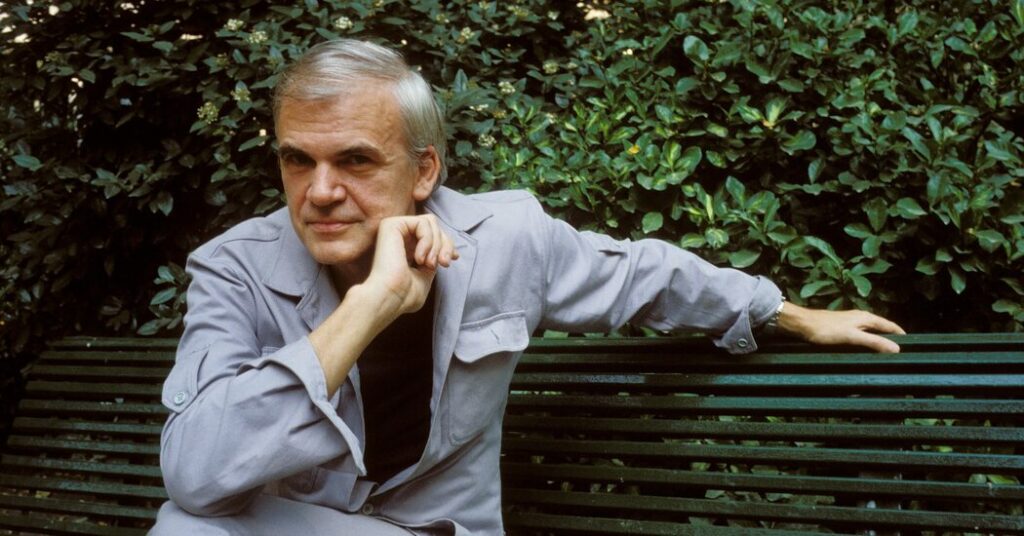
Milan Kundera, a prominent figure in European literature, passed away in Paris at the age of 94. He is best remembered for his 1984 masterpiece, “The Unbearable Lightness of Being.” Anna Mrazova, representing the Milan Kundera Library in Brno, Czech Republic, confirmed his demise following a prolonged illness.
Kundera’s literary journey was marked by his sharp critique of Czechoslovakia’s communist regime, leading him to seek refuge in France in 1975. His writings, a blend of poetry and satire, were celebrated for their keen insights into politics and daily life. Czech Prime Minister Petr Fiala acknowledged Kundera’s global impact, noting that his legacy includes both fiction and essays.
Born in 1929 to a musically inclined family, Kundera’s early life was deeply rooted in the arts. His initial allegiance to the Communist Party shifted as his writings, starting with his debut novel “The Joke,” drew political ire. The Soviet invasion of 1968 further strained his relationship with the regime, culminating in his emigration to France in 1975.
In France, Kundera’s reputation soared, especially with the release of “The Unbearable Lightness of Being,” which was later adapted into a film featuring Juliette Binoche and Daniel Day-Lewis. However, Kundera had reservations about the film adaptation and the novel’s reception in contemporary times.
Kundera’s literary contributions spanned various genres and themes. His 1979 work, “The Book of Laughter and Forgetting,” and the 1988 novel, “Immortality,” are among his notable works. While he was often considered for the Nobel Prize in Literature, it remained out of his grasp.
In his later years, Kundera faced allegations of betraying a Czech airman, which he vehemently denied. Support poured in from fellow authors, including JM Coetzee and Salman Rushdie. In 2019, four decades after losing it, Kundera and his wife had their Czech citizenship reinstated.
Kundera’s last novel, “The Festival of Insignificance,” published in 2014, received a mixed reception. His unique voice in literature, though occasionally critiqued for its portrayal of women, will be remembered for its depth and introspection.
For more on this story, visit BBC News.