


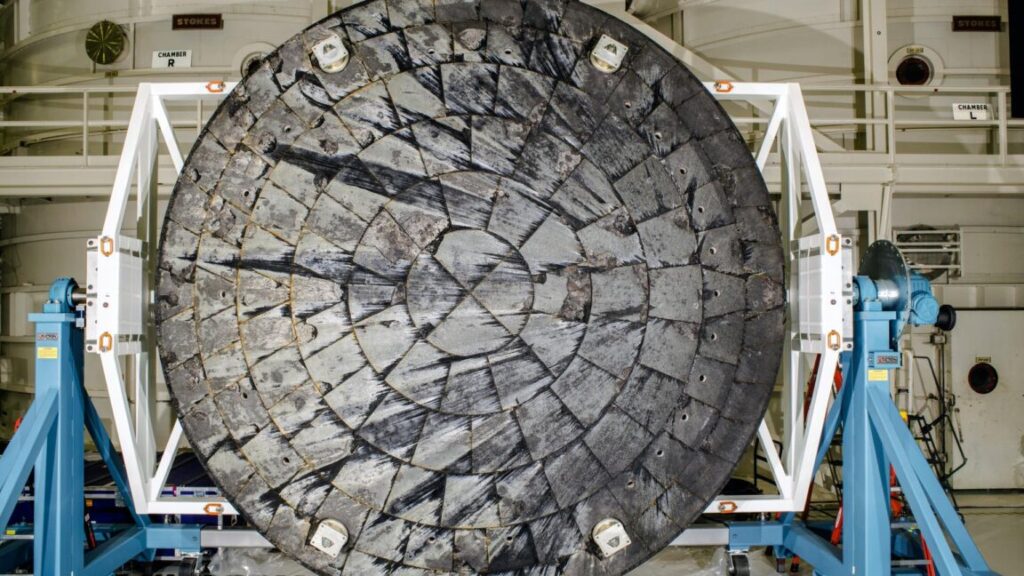
NASA Administrator Bill Nelson has thrown his full support behind the upgraded Orion spacecraft’s heat shield, which is set to play a critical role in the upcoming Artemis II mission. This assurance comes as the space agency pushes forward with its ambitious goal of landing astronauts back on the Moon by the middle of the decade. Following a meticulous review, Nelson expressed confidence in the heat shield, designed to protect the spacecraft and its astronauts from the extreme temperatures upon re-entry into Earth’s atmosphere.
The Role of the Heat Shield
The heat shield on NASA’s Orion spacecraft is a pivotal component, designed to withstand temperatures nearly as hot as the Sun’s surface as the capsule reenters Earth’s atmosphere at around 25,000 mph. This technological marvel is crucial not just for its protective properties but also for its lightweight design, which contributes to the overall efficiency of the mission. The shield’s performance is paramount in ensuring the safe return of astronauts aboard the Artemis II mission, which represents the first crewed mission in NASA’s Artemis program.
NASA has recently completed rigorous evaluations of the heat shield’s performance, following its use in the uncrewed Artemis I flight test. During this mission, the shield encountered temperatures exceeding 5,000 degrees Fahrenheit. Engineers and scientists meticulously analyzed the resulting data to affirm its robustness and reliability for future missions.
Enhancements and Testing
In preparation for Artemis II, NASA has incorporated enhancements into the heat shield design to improve its durability and performance. The recent intensive assessment concluded that these improvements are operating within expected parameters. Nelson’s endorsement of the shield’s readiness underscores NASA’s commitment to ensuring all aspects of the mission are thoroughly vetted and approved before launch.
The rigorous testing involved a series of evaluations, starting with ground-based assessments. Engineers utilized advanced simulation facilities to replicate the harsh conditions the spacecraft would encounter. This was followed by real-world validation during the Artemis I mission, where the heat shield was exposed to some of the most extreme conditions it will face in its operational lifespan.
Looking Ahead: The Artemis Program’s Future Missions
The Artemis program aims to achieve more than just Moon landings. By using the Moon as a proving ground, NASA intends to develop the capability to propel the next giant leap for humankind—sustainability on the Moon and eventually missions to Mars. The success of Artemis II is a critical step in this direction, setting the stage for subsequent missions that will lay the groundwork for lunar habitation and deeper space exploration.
Part of NASA’s broader strategy includes international partnerships and commercial collaborations, marking a new era of space exploration that leverages global expertise and resources. The success of the heat shield is just one aspect of a multifaceted strategy involving state-of-the-art technologies and innovative designs that will be integral to overcoming the challenges of deep space travel.
Innovations in Spacecraft Design
NASA’s Orion spacecraft, along with its heat shield, embodies cutting-edge space engineering. The innovations encompass lightweight materials, adaptive technologies, and precision engineering that collectively enhance the spacecraft’s safety, reliability, and performance. These advancements not only pave the way for near-term lunar missions but also establish a foundation for the eventual human exploration of Mars.
As Artemis II moves towards the final stages of preparation, the development team continues to fine-tune aspects of the mission, ensuring each component performs to the best of its ability. The precision with which NASA approaches these tasks highlights their unwavering commitment to astronaut safety and mission success, aspirations deeply rooted in their pioneering space exploration efforts.
With the heat shield’s readiness confirmed, NASA steadily advances towards the realization of its Artemis mission goals. The program’s success is poised to inspire a new generation of scientists and explorers, reigniting the human spirit of discovery and exploration in space.
As the world watches NASA’s progress with anticipation, the Artemis program stands as a testament to what is possible when expert knowledge, technology, and determination converge. Each successful milestone not only advances human capability in space but also sets a precedent for future generations to dream bigger and reach farther into the cosmos.
, image: https://arstechnica.com/space/2026/01/nasa-chief-reviews-orion-heat-shield-expresses-full-confidence-in-it-for-artemis-ii/