


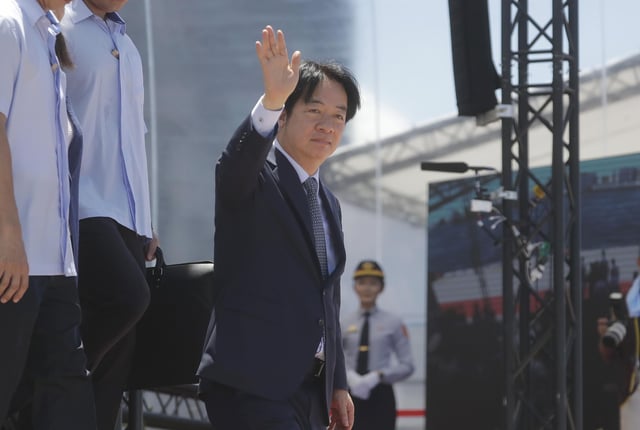
In a recent development that underscores the delicate balance of international diplomacy, Taiwan’s plans for a high-profile visit to New York by its president have been thwarted. Reports indicate that the move to block the visit came after intense diplomatic pressure, highlighting the intricate and often sensitive relationship between Taiwan, the United States, and China.
The Diplomatic Context
The decision to prevent Taiwan’s president from making a stopover in New York has brought the ongoing geopolitical tensions in the Asia-Pacific region into sharp focus. The United States, a crucial ally of Taiwan, frequently finds itself navigating the fine line of maintaining strong ties with Taipei while managing diplomatic exchanges with Beijing. This incident has placed a spotlight on the complex trilateral dynamics that influence these relationships.
Taiwan, officially the Republic of China, sees its status as distinctive from mainland China, the People’s Republic of China. However, Beijing considers Taiwan a breakaway province that will eventually be reunified with the mainland, by force if necessary. This geopolitical stance has led to a sensitive landscape where Taiwan’s international interactions often provoke reactions from China.
Impact on US-Taiwan Relations
The United States has long maintained an unofficial relationship with Taiwan, guided by the Taiwan Relations Act, which ensures that Washington provides Taipei with the arms necessary for self-defense. However, any move that could seem like formalizing diplomatic recognition is often met with firm opposition from Beijing. The cancellation of the Taiwanese president’s visit likely reflects Washington’s need to assuage Beijing’s concerns, avoiding a potential escalation of tensions in Sino-American relations.
This development could have significant implications for US-Taiwan relations, which have been robust yet unofficial since the US switched diplomatic recognition from Taipei to Beijing in 1979. Taipei’s international engagement strategy often involves transit visits through the United States, showcasing the support and recognition Taiwan seeks on the global stage. The blocked visit may signal a recalibration of these strategies under new diplomatic pressures.
Regional Reactions
Beyond the immediate actors, the situation has elicited varied reactions from the wider international community. Countries in the Asia-Pacific region are closely watching the evolution of US-China-Taiwan relations, which can influence regional stability and security dynamics. Neighboring nations, some of which have their own territorial disputes with China, are keenly observing how Washington’s policy adjustments affect the balance of power in the area.
China’s Stance
Unsurprisingly, China views Taiwan’s international forays, especially those involving high-profile engagement with the United States, with skepticism and often outright opposition. Beijing has continuously asserted that any engagement between US officials and Taiwanese leaders challenges China’s sovereignty claims over Taiwan. The move to block the Taiwan president’s New York stopover is likely seen as a diplomatic victory for China, reinforcing its claims without escalating to direct confrontation.
China’s foreign ministry has historically warned against any US actions that it perceives as legitimizing Taiwan’s sovereignty. The blocked visit aligns with past situations where China has employed diplomatic and economic pressures to limit Taiwan’s international space, aiming to isolate Taiwan on the world stage.
The nuanced handling of this situation by the United States indicates a continued effort to balance its commitments to Taiwan’s defense while managing the complexities of its critical relationship with China.
Future Implications
The repercussions of this canceled visit extend beyond immediate diplomatic fallout. For Taiwan, the incident serves as a reminder of the constraints it faces on the international platform, driven by Beijing’s geopolitical reach. For the United States, it remains a delicate dance of supporting an ally without triggering broader regional volatility.
As tensions in the region continue to simmer, eyes will be on future engagements and whether Taiwan will recalibrate its strategy in seeking international recognition and support. Similarly, the United States will need to consider its approach to ensuring regional stability while honoring its commitments to Taiwan amidst a rising China.
This incident is a stark reminder of the complexities that underpin Taiwan’s quest for a diplomatic presence and the intricate web of international relations that the US continues to navigate in the region.