


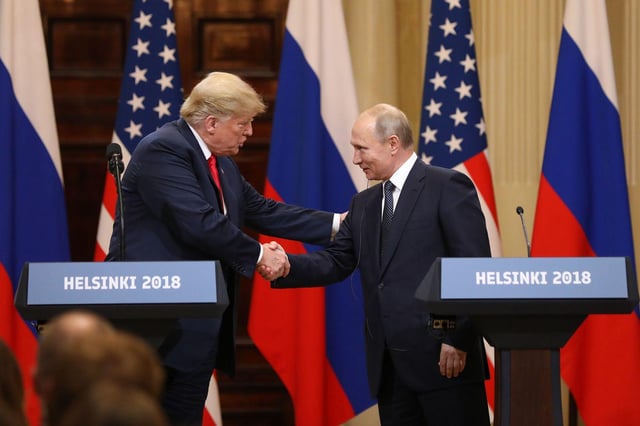
Recent revelations have surfaced about former U.S. President Donald Trump’s conversation with Russian President Vladimir Putin regarding the latter’s aggressive postures toward Ukraine. During a public discourse, Trump claimed that he explicitly warned Putin of severe consequences if Russia invaded Ukraine. According to Trump, he directly told Putin that he would “bomb the [expletive]” out of Russia if any action was taken against Ukraine.
Trump’s Statements Stir Political Waters
Trump’s bold remarks have injected fresh energy into discussions about his foreign policy approach while serving as president. Known for his unconventional style, Trump’s claim about the warning to Putin underscores his assertive stance on international diplomacy, particularly concerning the Russia-Ukraine conflict. These remarks have reignited debates over Trump’s foreign policy strategy and its implications for global geopolitics.
The specificity of Trump’s claims, however, has drawn skepticism and raised questions about the veracity and effectiveness of such diplomacy. Experts and political analysts are dissecting the implications of these statements, wondering how they were perceived by Putin and if they truly served as a deterrent during Trump’s administration.
Geopolitical Context and Reactions
The context of this claim is crucial, given the escalating tensions between Russia and Ukraine at various points over the last decade. Russia’s annexation of Crimea in 2014, followed by ongoing conflicts in Eastern Ukraine, has kept the region in perpetual instability. Trump’s statement, therefore, presents a stark reminder of the diplomatic tightrope walked by world leaders amid such crises.
International reactions to Trump’s alleged threat have been mixed. Some political commentators argue that an assertive stance toward Putin could have been an effective strategy in curbing Russian aggression. Others suggest that the threat of military action may have escalated tensions further, potentially prompting more aggressive posturing from Russia. Discussions about the warning—regardless of its diplomatic merit—illuminate the complexities of managing international conflicts.
How Washington and Moscow Might Interpret the Claim
In Washington, Trump’s remarks have been scrutinized through the lens of current foreign policy strategies. Some officials believe that his approach diverges significantly from more diplomatic avenues favored by current policymakers. For Moscow, the statements might be perceived as a provocation or as sabre-rattling, potentially influencing Russia’s contemporary foreign policy strategy.
Implications for Future Diplomacy
Understanding the nuances of Trump’s claim requires a broader look at historical U.S.-Russia relations. The diplomatic history between these two nuclear powers includes periods of détente as well as intense rivalry. Trump’s rhetoric, while characteristic of his tenure, adds another layer to the legacy of interactions between the two nations, possibly influencing future leaders’ strategies when dealing with Putin or similar figures.
The impact of Trump’s alleged threat lingers in the realm of speculation, yet it prompts important discussions about how assertive foreign policies should be and their potential consequences. The balance between showing strength and engaging in productive diplomacy remains a crucial consideration for any administration dealing with such complex international issues.
As the geopolitical landscape continues to evolve, Trump’s disclosures serve as a reminder of the multifaceted challenges of international statesmanship and the enduring influence of past leaders’ decisions on present-day policy-making. Whether or not his claims about direct threats to Russia’s leadership are conclusively confirmed, they underscore the high-stakes nature of global diplomatic engagements.