


The Czech Republic is emerging as a notable player in the wine industry, joining the ranks of renowned wine-producing regions like Napa, Bordeaux, and Tuscany. This resurgence is particularly evident in southern Moravia, the heart of the country’s wine production, and Bohemia. The revival of winemaking in these regions, which had dwindled post-war, gained momentum after 1989, leading to significant growth and innovative architectural developments in the industry.
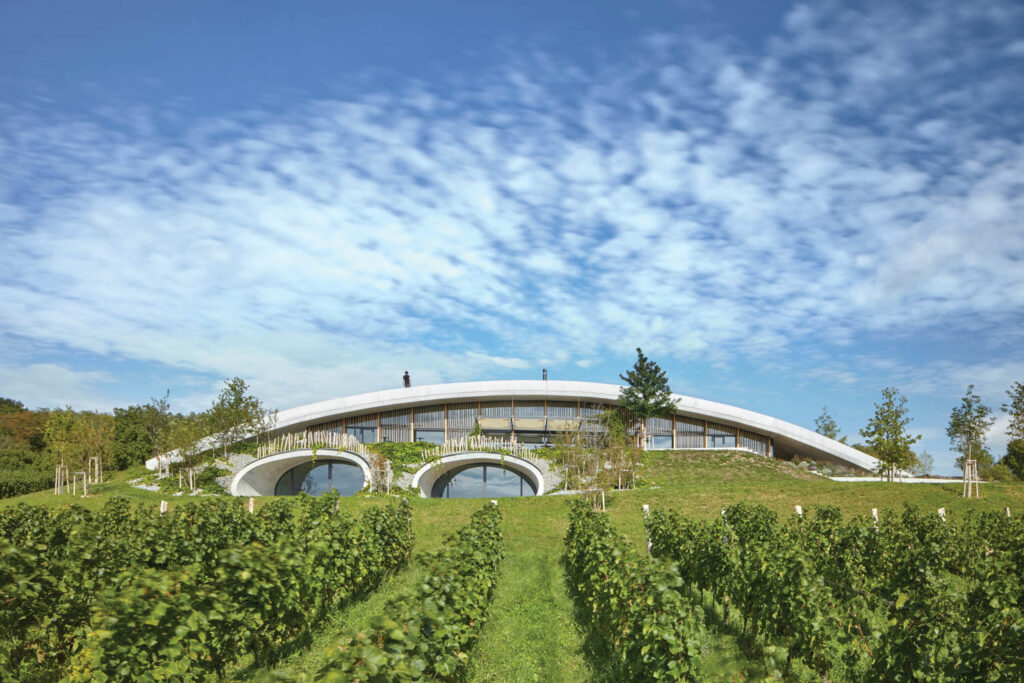
A prime example of this architectural innovation is the Gurdau Winery in Kurdějov, designed by Czech architect Aleš Fiala. Named after the village’s original German name, Gurdau, the winery’s structure is a remarkable sight, seamlessly blending boldness and subtlety. The building, an arch of reinforced concrete and glass, is nestled in the center of a 17-acre landscape of vineyards. These vineyards produce a variety of grapes, including Riesling, Veltliner, Pinot Blanc, and Merlot.
Founded in 2012, Gurdau Winery launched its first vintage in 2021, closely followed by the opening of its building in 2022 after two years of construction. The winery’s architecture pays homage to traditional winemaking practices, connecting with the old, local cellars that are often simple structures embedded in the hillside. However, Fiala’s contemporary design is far from modest. Spanning over 13,000 square feet on two levels, it serves as a pinnacle of production and hospitality.
The winery comprises a below-grade level with a separate entrance for shipments and deliveries, dedicated to producing 39,000 bottles annually. This level also houses a tasting room for archive wines and two intimate apartments for overnight guests. The ground floor, primarily customer-oriented, features a blackened-steel bar, a tasting area, and a dining room that can accommodate up to 40 people. Large sliders open up to an acacia terrace, offering stunning views of the vineyards.
Sustainability is a key aspect of Gurdau Winery’s design. The building’s location within the vineyard minimizes the transport of raw materials and workers. Most production zones are located underground, and customer areas are sunlit through large glass spans. The winery also collects rainwater for irrigation and uses thermally insulated triple glazing, oak slats, and an overhanging curved roof to mitigate summer heat.
The winery’s construction primarily utilizes reinforced concrete, local acacia, oak, and gray cement screed. The interior features blackened steel and aluminum structural elements, along with contemporary furnishings by designers like Ronan & Erwan Bouroullec and Piero Lissoni, mixed with custom pieces.
Aleš Fiala’s deep connection to the region and viniculture is evident in his work. He shares his personal favorite wine from Gurdau, the 2021 Vesnice Kurdejov Grüner Veltliner, which pairs well with classic wiener schnitzel. Gurdau Winery stands as a testament to the harmonious blend of tradition, innovation, and sustainability, making a significant mark in the Czech wine industry.
For more details and to explore the winery’s design, you can read the original article on Interior Design.