 Jan Nettig
“Prague Spring” is a phrase most educated people recognize but few can fully explain. Between January and August 1968, Czechoslovakia attempted to reform communism from within — creating what its architect Alexander Dubček called “socialism with a human face”. It ended when Warsaw Pact tanks rolled into Prague on the night of 20-21 August 1968. This is the full history.
Quick summary
- Dates: 5 January 1968 (Dubček elected First Secretary) — 21 August 1968 (Warsaw Pact invasion).
- Location: Czechoslovakia, especially Prague.
- Key figures: Alexander Dubček (First Secretary), Ludvík Svoboda (President), Josef Smrkovský (National Assembly).
- Outcome: Warsaw Pact invasion, “normalization” imposed by Moscow, 200,000+ Czechs emigrated. Reform crushed but the ideas outlived the tanks.
The context — Czechoslovakia in 1967
Czechoslovakia in the late 1960s was one of the most orthodox Communist regimes in the Warsaw Pact. Antonín Novotný’s Stalinist administration had failed to deliver economic reforms while Poland and Hungary were experimenting. The economy stagnated. Slovak resentment of Prague-centric government grew. Students protested. Writers — Milan Kundera, Ludvík Vaculík, Václav Havel — pushed openly against censorship at the Fourth Congress of the Czechoslovak Writers’ Union in June 1967.
In December 1967, the Central Committee split. Novotný was forced out. On 5 January 1968, Alexander Dubček — a moderate Slovak reformer — was elected First Secretary of the Communist Party.
The reforms — “socialism with a human face”
Between January and August 1968, Dubček’s government implemented a rapid series of reforms:
- Freedom of the press — censorship suspended in March 1968. Writers, journalists, and academics published freely for the first time in twenty years.
- Freedom of assembly and travel — Czechoslovak citizens could travel to the West without special permits.
- Economic decentralization — proposals for market-socialist reforms (led by economist Ota Šik) allowing enterprises to respond to demand rather than central plans.
- Federalization — plans to split Czechoslovakia into a federal republic with equal Czech and Slovak lands.
- Multi-candidate elections within the Communist Party — not multi-party democracy, but real choice within the ruling party.
- Rehabilitation of political prisoners from the Stalinist show trials of the 1950s.
The reforms were codified in the Action Programme of April 1968. Dubček repeatedly stressed that Czechoslovakia was not leaving the Warsaw Pact and was not abandoning socialism — the reforms were “socialism with a human face”.
The Two Thousand Words
On 27 June 1968, the writer Ludvík Vaculík published Dva tisíce slov (“Two Thousand Words”) — a manifesto signed by 70 prominent Czechs and Slovaks urging citizens to push the reforms further and defend them against internal and external threats. It went far beyond what Dubček’s leadership was comfortable with, but caught the imagination of the public. Moscow interpreted it as a threat to communist rule.
Moscow’s response
Leonid Brezhnev and the Soviet Politburo watched the Prague Spring with mounting alarm. Warsaw Pact members Poland, East Germany, Bulgaria, and Hungary sided with Moscow.
Multiple diplomatic pressures were tried — the Warsaw Letter (July 1968), the Cierna nad Tisou meetings, the Bratislava Declaration. Each time, Dubček signed statements affirming Warsaw Pact loyalty. Each time, the reforms continued at home.
By mid-August 1968, Brezhnev decided the only remaining option was military intervention. The reasoning was later codified as the “Brezhnev Doctrine” — the assertion that any socialist state’s move away from Soviet-model socialism was a legitimate concern of all socialist states.
The invasion — 20-21 August 1968
Around 23:00 on the night of 20 August, Warsaw Pact forces — approximately 200,000 troops from the Soviet Union, Poland, East Germany, Bulgaria, and Hungary — crossed into Czechoslovakia. By dawn on 21 August they controlled Prague’s airport, government buildings, and radio station.
Dubček and other leaders were arrested and flown to Moscow.
Czech and Slovak citizens responded with mass non-violent resistance. Radio and TV broadcasters stayed on the air from clandestine locations. Streets signs were removed to confuse invading troops. Citizens climbed onto tanks to argue with soldiers. Over 100 Czechs and Slovaks were killed by Warsaw Pact forces in the first weeks.
In Moscow, Dubček was forced to sign the Moscow Protocols agreeing to reverse the reforms. He was returned to Prague as First Secretary but stripped of real power.
Normalization — 1969 to 1989
Dubček was gradually removed. In April 1969, Gustáv Husák — a Slovak hardliner — replaced him. The reforms were reversed one by one. Censorship returned. Hundreds of thousands of Communist Party members were purged. Writers were banned. An estimated 200,000 Czechs and Slovaks emigrated between 1968 and 1970 — including Milan Kundera, Miloš Forman, and countless others.
The 20-year period from 1969-1989 is known as “normalization” — a bleak, grey era of Soviet-style orthodoxy that ended only with the Velvet Revolution of November 1989. See our November 17 anchor guide for what followed.
The martyrs
Jan Palach — a 20-year-old philosophy student who set himself on fire on Wenceslas Square on 16 January 1969 to protest the passivity of Czechs after the invasion. He died three days later. His funeral drew hundreds of thousands. The location is marked today by a bronze cross set into the pavement below the Wenceslas statue.
Jan Zajíc — followed Palach with a similar self-immolation on 25 February 1969.
Josef Toufar, Milada Horáková, and other victims of earlier Stalinist repression were commemorated during the Prague Spring but suppressed again during Normalization.
Where to visit in Prague today
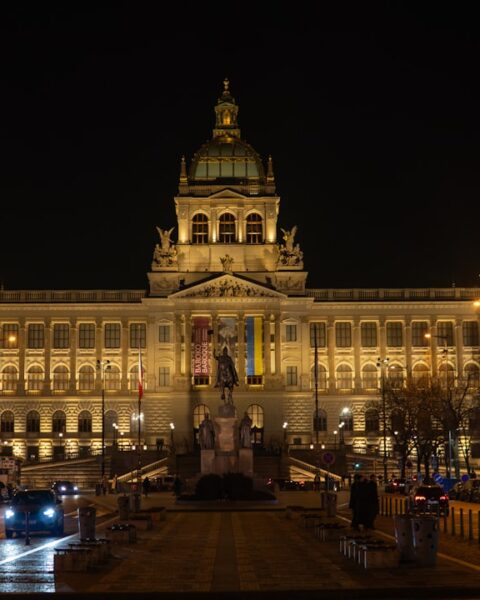
- Jan Palach memorial — bronze cross in the pavement at the top of Wenceslas Square, in front of the National Museum.
- Museum of Communism — V Celnici 4, near náměstí Republiky. Substantial section on the Prague Spring and normalization.
- Radio building at Vinohradská 12 — where broadcasters resisted during the invasion. Plaque commemorates those killed defending it.
- Wenceslas Square — site of self-immolations, tank confrontations, and later of the 1989 revolution rallies.
- Vyšehrad Cemetery — many Prague Spring figures are buried here.
To read more
- “The Prague Spring and Its Aftermath” by Kieran Williams — the definitive academic account.
- “The Unbearable Lightness of Being” by Milan Kundera — the novel set during and after the Prague Spring.
- “Havel: A Life” by Michael Žantovský — Havel’s role in 1968 and after.
- “Postwar: A History of Europe Since 1945” by Tony Judt — the essential single-volume history of the whole era.
FAQ
What was the Prague Spring?
A 1968 attempt by reform-minded Czechoslovak communists led by Alexander Dubček to liberalize the country’s Communist system. Ended by Warsaw Pact invasion in August 1968.
Why did the USSR invade Czechoslovakia?
The Soviets feared that Czechoslovak reforms would encourage similar movements in other Warsaw Pact countries and threaten the Soviet bloc as a whole.
Did the Prague Spring succeed?
Short-term no — reforms were reversed. Long-term the ideas influenced 1989’s Velvet Revolution and post-communist transitions across the region.
What’s the connection between the Prague Spring and the Prague Spring music festival?
None directly. The music festival is called Pražské jaro and predates the 1968 political events by decades.