 Kristina Vankova
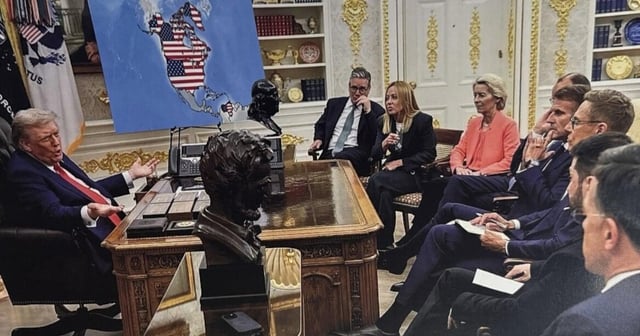
In a move that’s generating considerable attention and discussion, former President Donald Trump has shared an altered map showcasing the U.S. flag extending over the entirety of Canada. This latest gesture has sparked a flurry of conversation online, blending political commentary with a touch of artistic expression. The altered map, which Trump reportedly shared on his verified social media platforms, adds fuel to ongoing conversations about American-Canadian relations, as well as debates about nationalism and international borders.
The image itself is as striking as it is controversial. By featuring an expansive American flag stretching beyond the traditional U.S. borders to cover Canada, the map evokes a variety of interpretations and reactions. To some, it represents a bold political statement about North American unity or dominance; to others, it may be seen as provocative or even an affront to Canadian sovereignty. As the image circulates, reactions are pouring in from politicians, citizens, and social media users in both countries.
Public Reaction and Political Implications
The altered map has not just stayed within the confines of social media platforms but has also reached mainstream media discussions, escalating the dialogue surrounding it. In Canada, many have reacted with humor, with some Canadians adopting the image as a meme to poke fun at what they see as typically bold American exuberance. However, there are instances of genuine concern, with critics questioning the underlying message or intentions of altering the geographical depiction in such a way.
In the U.S., opinions are mixed. Supporters of Trump might view it as an audacious and tongue-in-cheek gesture that reaffirms a strong sense of American identity and international ambition. For others, the image raises critical questions about the implications of such symbolism, against the backdrop of America’s real-world foreign policies and relations with its northern neighbor.
Artistic Expression or Political Statement?
This incident is a prime example of how digital content can straddle the line between artistic expression and political statement. The very nature of altering a map—traditionally a representation of fact and geography—can blur into the realm of what could be considered propaganda or satire, depending on the interpreter’s perspective. This duality exemplifies the complex interplay between media, politics, and art in the digital age.
Art has often been utilized as a vehicle for political commentary, and the internet has only amplified this potential. Altered maps, graphics, and images can rapidly disseminate, reaching global audiences and eliciting diverse responses. Trump’s shared map thus invites discussion about the role of such imagery in political discourse, particularly how visual alterations can influence public perception or sentiment.
The Broader Context of U.S.-Canadian Relations
This graphic comes in the context of a nuanced and sometimes strained relationship between the United States and Canada. Historically, the two countries have been close allies, with extensive economic ties and cooperative defense agreements such as NORAD. However, recent years have seen tensions arise over trade negotiations, defense spending, and differing stances on international climate policies.
Critically, the map’s symbolism may reflect certain American perspectives about engagement and relationships not just with Canada, but on the global stage. It provokes renewed examination of national identity and international roles at a time when cross-border issues—including immigration and trade—are highly politicized.
Ultimately, the discussion stirred by this map underscores a broader dialogue about symbolism, borders, and national identity in an increasingly interconnected world. While the image itself may fade from the forefront of public discourse, the themes and questions it raises remain deeply relevant to contemporary political and cultural narratives.